How to Size a Portable Power Station & Solar Array by Real Watt-Hours
Avoid undersized backup batteries by applying real inverter loss, motor startup surge math and outdoor solar derating before buying.
Sizing a portable power station solely by dividing its advertised watt-hours (Wh) by your appliance wattage leads to dead batteries hours early. Real-world backup planning requires three checks: usable AC efficiency, inverter startup surge, and realistic outdoor solar harvest.
Step 1: Calculate real usable watt-hours
Battery capacity printed on the box represents DC cell storage. When you plug household appliances into the 120V AC wall sockets, the built-in pure sine wave inverter loses roughly 15% to conversion and standby overhead:
- AC runtime formula:
(Battery Wh x 0.85) / Load Watts = Real Hours - DC 12V / USB-C runtime formula:
(Battery Wh x 0.92) / Load Watts = Real Hours
Tip for overnight CPAP or router backup: using a dedicated 12V DC adapter instead of the AC wall brick avoids turning the AC inverter on at all, commonly extending overnight runtime by 25% to 35%. Test your exact loads in our free Portable Power Station Runtime & Solar Calculator.
Step 2: Check both running watts and motor startup surge
Resistive heaters (kettles, toasters, hair dryers) draw steady watts with almost no surge. Motor-driven loads (refrigerators, sump pumps, power tools) pull 3x to 5x running wattage for a fraction of a second on startup.
| Household Backup Load | Typical Running Watts | Startup Surge | Minimum Inverter Class |
|---|---|---|---|
| Wi-Fi Router + Cable Modem | 15 to 25 W | Minimal | 300 W+ (DC preferred) |
| CPAP Machine (no heat / humidifier) | 30 W / 70 to 90 W | Minimal | 300 W+ (12V DC best) |
| Full-Size Kitchen Refrigerator | 120 to 200 W (~60W avg) | 600 to 1,200 W | 1,200 W to 1,800 W |
| Microwave / Coffee Maker | 1,000 to 1,500 W | Resistive (1x) | 1,800 W to 2,200 W |
Compare continuous vs surge inverter specs and LiFePO4 cycle counts in our portable power station comparison.
Step 3: Size foldable solar panels with outdoor derating
To refill a 1,024Wh battery in one clear afternoon (about 5 peak sun hours), remember a portable panel typically harvests 65% to 75% of its rated wattage outdoors: - One 200W panel averages roughly 140W to 150W real input, needing ~7 peak sun hours for a full 0-to-100% refill. - Two 200W panels (400W rated, ~300W real) refill a 1,024Wh unit in ~3.5 to 4 peak sun hours.
Always verify two electrical limits on the power station spec sheet before connecting panels: Maximum Solar Input Voltage (Voc ceiling) and connector type (XT60, Anderson or MC4 adapter). Exceeding the station maximum open-circuit voltage (Voc) can permanently damage the MPPT charge controller, especially in freezing morning air when solar voltage spikes slightly. Check voltage ratings in our foldable solar panel guide.
Backup power & solar FAQ
Why does a 1,000Wh power station not run a 100W device for 10 full hours on AC?
Converting DC battery voltage into 120V AC through the internal inverter consumes roughly 10% to 15% of battery energy as heat and idle draw. Expect roughly 800 to 850 usable watt-hours on AC outlets, or about 8.0 to 8.5 hours at 100W.
How many watts does a full-size refrigerator actually need on backup power?
Modern full-size kitchen refrigerators typically draw 120W to 200W while the compressor runs, averaging roughly 50W to 75W per hour over a 24-hour cycle. However, compressor startup surges briefly reach 600W to 1,200W, requiring an inverter rated at least 1,000W to 1,500W continuous.
Why does a 200W portable solar panel usually output 130W to 160W outdoors?
Panels are rated under laboratory Standard Test Conditions (25 C cell temp, perpendicular 1,000 W/m2 light). Real outdoor heat, haze and panel angle normally deliver 65% to 80% of rated watts under clear skies.
Is LiFePO4 worth the extra weight over older lithium-ion NCM stations?
For home backup and frequent cycling, yes. LiFePO4 cells typically specify 3,000+ cycles to 80% capacity and stronger thermal stability, whereas older NCM cells often rate 500 to 800 cycles.
More backup power guides
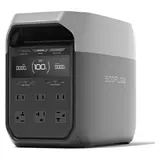 Power StationsBest Portable Power Station: 5 Top Picks (2026)Compare top LiFePO4 power stations by AC output, battery capacity, recharge speeds, and port options for emergency backup and outdoor use.Read
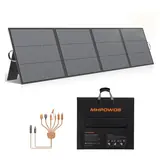 Solar PanelsBest Foldable Solar Panel: 5 Top Picks (2026)Compare top foldable solar panels by wattage, cell efficiency, weight, and connector compatibility for power stations and outdoor charging.Read
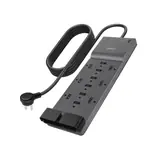 Power Strips & CablesBest Heavy Duty Surge Protector: 6 Top Picks (2026)Compare top heavy-duty surge protector strips by joule energy absorption, AC outlet counts, cord length, USB output, and overload safety.Read
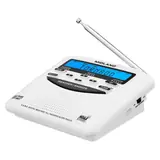 Outage BackupBest Emergency Weather Radio: 6 Top Picks (2026)Compare top emergency weather radios by NOAA reception, SAME county code filtering, hand crank charging, battery capacity, and power backup.Read